
Views: 0 Author: Site Editor Publish Time: 2026-10-20 Origin: Site


The visual impact of a fully stocked gelato case drives impulse purchases. However, the operational reality of managing that inventory dictates your daily profitability. Selecting a cabinet that is too small limits revenue potential. It also causes severe restocking bottlenecks during peak rushes when your staff should be focused on serving customers. On the flip side, selecting one that is too large leads to high energy costs and rapid product degradation. You also risk the unappealing look of half-empty pans during slow periods, which signals stale product to your buyers. We need to establish a strict framework for evaluating your shop's footprint, flavor strategy, foot traffic, and technical specifications. This evaluation helps determine the optimal gelato display cabinet size for your specific business model. Getting this right prevents wasted floor space and keeps your product texture perfect.
12-pan units are optimal for cafes, restaurants, or lean startups prioritizing high turnover, product freshness, and lower upfront capital.
20-pan units are required for dedicated gelaterias with high foot traffic, extensive seasonal rotations, and the dedicated production staff to support them.
Pan configuration matters: The choice between 1/4, 1/3 (5-liter), and 1/2 (7-liter) Napoli pans impacts visual abundance, flavor variety, and restocking frequency just as much as the total cabinet footprint.
Matching your equipment capacity to actual foot traffic and sales volume is the foundational step in shop design. A common misstep among new operators is purchasing the largest case that fits in the floor plan without calculating the daily turnover required to keep that case looking fresh. You must evaluate your expected daily scoop volume against the physical capacity of the pans. A standard 5-liter Napoli pan yields approximately 40 to 50 scoops depending on your portion control and overrun. If your location data suggests you will sell 300 scoops a day, you are turning over roughly six to seven pans of product. In a 20-pan configuration, this means the majority of your inventory will sit in the case for three to four days. This extended holding time leads to texture degradation, ice crystallization, and flavor loss.
The psychological risk of visual depletion cannot be overstated. Customers eat with their eyes first. An oversized, half-empty cabinet deters customers by signaling that the product is old or that the business is struggling. A smaller, densely packed commercial gelato display cabinet overflowing with freshly swirled product creates a perception of high demand and premium quality. You must balance the desire to offer a wide variety of flavors with the operational imperative to maintain a visually abundant display from open to close.
Your flavor strategy directly dictates your hardware requirements. You need to define your baseline menu before looking at equipment specifications. A lean strategy might consist of eight core staples that never change, alongside four rotating seasonal slots. This approach perfectly aligns with a 12-pan chassis. However, if your market demands dedicated space for vegan, dairy-free, or highly experimental options, a smaller case forces you to cannibalize top sellers to make room for niche products. In those scenarios, expanding to a larger footprint becomes necessary to protect your core revenue drivers while still catering to specialized dietary preferences.
Expected Daily Sales (Scoops) | Recommended Cabinet Size | Estimated Pan Turnover Rate | Ideal Business Type |
|---|---|---|---|
Under 150 | 4 to 8 Pans (Countertop) | 1-2 days | Food trucks, small cafes, kiosks |
150 to 400 | 12 Pans | 1-3 days | Bakeries, restaurants, startup shops |
400 to 800+ | 18 to 24 Pans | 1-2 days | Dedicated gelaterias, tourist spots |
There are also scenarios where a standard floor model is entirely the wrong choice. Ultra-lean operations, food trucks, or highly restricted square footage environments should often bypass floor models entirely. A three to four-pan countertop unit provides the ability to add a high-margin dessert category without sacrificing valuable floor space or requiring complex electrical installations. Establishing this baseline ensures you do not overcapitalize on equipment that your physical space or business model cannot support.
The 12-pan configuration serves as the ultimate workhorse for mixed-use culinary spaces. Coffee shops, bakeries, and restaurants frequently utilize this size to add artisanal frozen desserts as a high-margin secondary revenue stream. It provides enough visual presence to draw attention without dominating the entire front-of-house layout. Boutique startups testing a local market also gravitate toward this size. It forces a highly curated, artisanal menu that simplifies back-of-house production schedules and keeps inventory tight.
The primary advantages of a 12 pan gelato display cabinet revolve around footprint and freshness. The reduced physical dimensions allow for flexible placement within existing counter line-ups. More importantly, the smaller capacity enforces faster product turnover. Gelato is highly sensitive to temperature fluctuations and prolonged storage. By holding less inventory on the floor, you ensure that customers receive a product with superior texture and mouthfeel. The rapid turnover prevents the structural breakdown and icy texture that plagues slow-moving flavors in oversized cases.
However, this lean approach carries distinct scaling risks. During peak summer hours or sudden post-dinner rushes, a 12-pan unit can create severe service bottlenecks. If a popular flavor sells out in the middle of a rush, staff must abandon the service counter to retrieve backup pans from the back-of-house storage freezer. This disrupts the flow of service and increases customer wait times. Furthermore, the limited real estate means you cannot showcase a wide variety of options, potentially losing sales from large groups where one customer is seeking a highly specific or niche flavor profile.
Operators can maximize a 12-pan footprint through strategic container selection. Utilizing narrow 1/4 pans allows you to artificially increase the flavor count within the same physical chassis. By swapping standard wide pans for narrow configurations, you can offer 16 smaller batches in a 12-pan footprint. This tasting-menu style setup provides the illusion of vast variety while maintaining the rapid turnover benefits of a smaller cabinet. It requires more frequent restocking but significantly enhances the customer's perception of choice.
Standardize your core menu to eight permanent flavors that drive 80% of your sales.
Reserve the remaining four slots for high-margin seasonal rotations to create urgency.
Keep backup pans of your top three sellers pre-garnished in the back-of-house freezer.
Train staff to swap empty pans in under thirty seconds to prevent line abandonment during rushes.
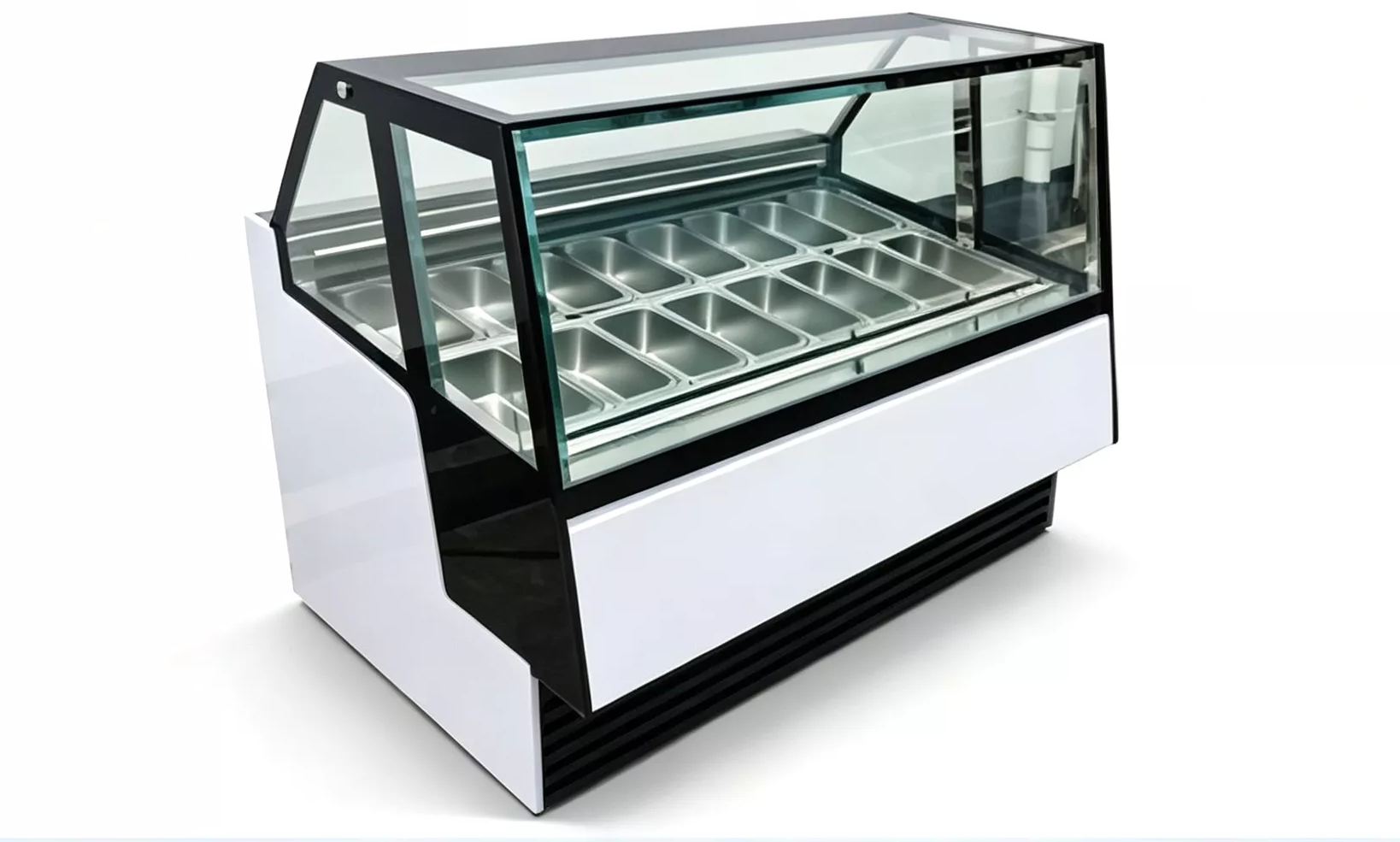
When a business model relies entirely on frozen dessert sales, scaling up to a 20-pan unit is often mandatory. Dedicated, high-volume gelaterias, tourist destinations, and flagship retail locations require the massive visual impact that only a large-format case can provide. In these environments, the cabinet is not just a piece of storage equipment; it is the central architectural feature of the store. It creates a definitive visual anchor, presenting a colorful, sweeping landscape of product that commands attention from the moment a customer walks through the door.
The primary advantage of this scale is menu breadth. A 20-pan layout provides sufficient real estate to merchandise a comprehensive menu without sacrificing core bestsellers. You can dedicate entire sections of the case to chocolate variations, fruit sorbets, and nut-based classics, while still reserving ample space for weekly experimental batches. This extensive variety caters to diverse demographics and encourages repeat visits, as customers return to try flavors they noticed during their previous purchase.
Scaling up introduces significant operational limitations regarding labor, waste, and energy. A 20-pan case requires a substantial increase in daily labor hours. Morning setup involves pulling, mapping, and garnishing 20 individual pans. Evening teardown requires moving all that product back to storage freezers, followed by the deep cleaning of a massive glass and stainless steel chassis. If the daily sales volume does not support the capacity, the business will suffer from high product shrinkage as unsold gelato degrades and must be discarded.
Furthermore, the environmental impact on the shop is profound. A larger compressor generates significantly more heat rejection and noise. The shop's HVAC system must be robust enough to counteract the heat exhausted by the cabinet's condenser. Otherwise, the ambient temperature of the store will rise to uncomfortable levels, forcing the cabinet to work even harder to maintain safe holding temperatures. This creates a negative feedback loop that shortens the lifespan of the compressor.
Operational Metric | 12-Pan Cabinet | 20-Pan Cabinet |
|---|---|---|
Average Setup Time | 15 - 20 minutes | 35 - 45 minutes |
Daily Cleaning Time | 20 minutes | 40+ minutes |
Heat Rejection (BTU) | Moderate (Standard HVAC) | High (Requires dedicated ventilation) |
Visual Impact | Curated and artisanal | Expansive and dominant |
Evaluating an ice cream display cabinet requires looking past the simple pan count and understanding the thermodynamics and ergonomics of the unit. Pan dimensions, orientation, and container matching dictate the daily workflow of your staff. The industry standardizes around 1/4, 1/3 (5-liter), and 1/2 (7-liter) Napoli pans. You must match the case specifications to your planned containers to ensure seamless day-to-day use. A case designed strictly for wide pans will leave unsightly gaps if you attempt to use narrow inserts without the proper adapter bars.
Orientation directly affects both customer visibility and scooping ergonomics. Wide pan orientations present a larger surface area of product to the customer, enhancing visual appeal. However, they force the staff to reach further into the case, which can cause ergonomic strain over a long shift. Narrow orientations allow more flavors to fit horizontally across the glass, reducing the depth of the reach for the server but slightly diminishing the visual impact of each individual flavor. You have to decide whether staff comfort or maximum visual exposure takes priority in your specific layout.
Refrigeration technology and airflow management separate entry-level units from professional-grade equipment. Gelato requires precise, slightly warmer serving temperatures compared to traditional hard-pack ice cream to maintain its signature silky texture. Ventilated, or forced-air, cooling systems circulate cold air over the surface of the product, ensuring consistent temperatures from the front of the case to the back. In larger 20-pan units, dual airflow systems become critical. Without dual airflow, temperature stratification occurs, causing the gelato in the front row to melt while the product in the back row freezes solid.
Aesthetics also play a functional role in shop design. A curved glass ice cream display cabinet provides traditional European aesthetics and improves customer sightlines by reducing overhead lighting glare. The curvature naturally draws the eye downward toward the product. Conversely, straight or flat glass profiles cater to modern, minimalist shop designs. Flat glass is generally easier to clean and, depending on the height and structural integrity of the case, can sometimes serve as a secondary transaction counter for handing products to customers.
The initial purchase price of the equipment is only a fraction of your financial commitment. Operators must analyze the price delta between 12-pan and 20-pan models of the same tier while factoring in the ongoing operational costs. A larger cabinet utilizes a more powerful compressor, which draws significantly more amperage. Calculating the monthly energy consumption differences is vital for accurate financial forecasting. Additionally, the cost of product shrinkage in larger units can quickly erode profit margins if the shop does not maintain the volume required to turn over 20 pans of inventory efficiently.
Sourcing your equipment directly from a reputable gelato display cabinet manufacturer provides distinct advantages regarding long-term reliability. You must evaluate the compressor warranties, the availability of replacement parts, and the manufacturer's access to local service technician networks. A cabinet that goes down in the middle of July can cost a business thousands of dollars in lost revenue and melted product. Fast access to OEM parts and qualified technicians is non-negotiable. Always ask the manufacturer for a list of authorized service agents in your zip code before finalizing the purchase.
There are also instances where standard catalog models simply will not work for a specific space. Unique architectural constraints, such as structural pillars, unusually low windows, or highly specific brand design languages, may require you to invest in a custom gelato display cabinet. While custom units require a higher initial investment and longer lead times, they allow operators to maximize every inch of available retail space. A custom build ensures a completely seamless integration with the front counter millwork, eliminating awkward gaps that trap dust and debris.
Proper space planning and ergonomics are critical during the implementation phase. A common failure point is neglecting to measure adequate clearance for staff movement. The area behind the cabinet must accommodate the physical depth of the staff, the swing radius of the cabinet's rear doors or pull-down night blinds, and the space required to comfortably extract heavy, full pans of product. If the aisle is too narrow, service speed plummets and the risk of dropping product increases. You need a minimum of 36 inches of clearance behind the case for safe operation.
Managing condenser heat exhaust is another major implementation risk. Refrigeration units do not create cold; they remove heat. That heat must go somewhere. For built-in or flush-mounted units, you must ensure strict adherence to the manufacturer's ventilation requirements. Blocking the intake or exhaust louvers will cause the compressor to short-cycle, leading to premature mechanical failure and inconsistent product temperatures. Always consult with your millworker to ensure adequate airflow channels are built into the counter design.
Managing inventory during off-peak seasons requires strategic merchandising. A 20-pan case that looks vibrant in July can become a massive liability in January. To maintain a full, abundant appearance without overproducing product that will go to waste, operators should utilize dummy pans, smaller inserts, or false bottoms. These tactics elevate a smaller volume of product closer to the glass, creating the illusion of a fully stocked pan while drastically reducing the actual volume of inventory sitting on the floor. This keeps your display looking professional without destroying your food cost percentages.
Measure your exact doorway dimensions and compare them against the crated shipping dimensions of your shortlisted cabinets to ensure delivery access.
Consult with a licensed commercial refrigeration technician to verify your electrical panel can handle the specific amperage draw of the unit.
Map out your baseline flavor menu on paper to determine exactly how many standard or narrow pans you need before placing an equipment order.
Request detailed specification sheets from the manufacturer to confirm the required clearance for condenser ventilation and staff workflow.
A: A startup should generally launch with 12 to 16 flavors. This range provides enough variety to satisfy different palates without overwhelming the production staff. It also prevents high product waste during the initial months of building a customer base.
A: Yes, but it requires specific adapter bars. Most gelato cabinets are designed for rectangular Napoli pans. To use round standard ice cream tubs, you must install stainless steel tub holders or adapter frames to secure the round containers and prevent cold air from escaping.
A: The primary difference is temperature control and airflow. Gelato is served warmer than traditional ice cream. Gelato cases use precise forced-air ventilation to maintain this delicate, warmer temperature consistently without melting the product.
A: Yes. Because frozen custard is dense and served at slightly warmer temperatures similar to gelato, a high-quality ventilated cabinet can easily be calibrated to hold and display frozen custard perfectly. You simply adjust the digital thermostat to match your specific product.
A: The glass shape itself does not dictate temperature control; the refrigeration system does. However, curved glass often features specialized pyrolytic heating films to prevent condensation, and its aerodynamic shape inside the case can sometimes assist the smooth circulation of forced air.
A: Most modern ventilated cabinets feature automatic reverse-cycle or hot-gas defrost systems that run every four to six hours. However, operators should still perform a complete manual teardown, powering off the unit for a deep clean and full ice melt, at least once a week.


