
Views: 0 Author: Site Editor Publish Time: 2025-11-21 Origin: Site


Selecting the right infrastructure for your inventory or collection is never a passive decision. A glass display case represents a critical balance between two opposing forces: protection and presentation. You need a barrier that secures valuable assets from theft and environmental damage, yet that barrier must be virtually invisible to ensure the item remains the hero. Whether you are a retailer maximizing floor yield or a private collector preserving vintage artifacts, the specifications you choose today dictate the longevity of your display.
The market landscape for 2026 has shifted dramatically. The discontinuation of budget-friendly staples like IKEA’s Detolf series has left a "void" in the entry-level market, driving buyers toward more robust, commercial-grade solutions. Simultaneously, we see a rise in modular systems and a strict demand for high-CRI LED integration in retail environments. This guide evaluates the best glass display cases currently available, analyzing options for commercial retail and high-end private collections based on structural integrity, material clarity, and Total Cost of Ownership (TCO).
Purpose Dictates Structure: Retail "Full Vision" cases prioritize sales volume, while "Museum/Collector" grades prioritize preservation and dust sealing.
Material Trade-offs: Acrylic offers 17x impact resistance and lower weight, while Tempered Glass offers superior scratch resistance and rigidity for heavy loads.
Lighting Quality: Standard LEDs are insufficient; look for CRI >90 and 30-degree viewing angles to minimize glare on glass panels.
Logistics Matter: Freight costs and assembly complexity (flat-pack vs. pre-assembled) often double the initial budget of budget-friendly cases.
The technical requirements for a display cabinet change entirely based on its end-use. A high-traffic retail store requires speed and durability, while a private archive demands absolute environmental isolation. Understanding this distinction prevents costly procurement errors.
In a commercial setting, the cabinet is a sales tool. It must facilitate transactions while preventing shrinkage. For high-value items, specific ergonomic features are non-negotiable.
When selecting a Jewelry Display Cabinet, the primary focus must be on accessibility paired with aggressive security. Staff cannot fumble with keys or struggle to reach inventory while a customer waits. We recommend prioritizing units with "pull-out decks." These drawers extend approximately 18 inches toward the salesperson, allowing them to present a tray without removing it fully from the secure zone. Security in these units should move beyond simple cam locks; look for high-security plunger locks that are difficult to pick or drill.
Conversely, food service environments face biological challenges. A Bakery Display Cabinet prioritizes hygiene and volume presentation. Here, the "Full Vision" aesthetic often gives way to angled front glass which reduces glare from overhead store lights. More importantly, these cases require curved, seamless glass fronts to eliminate crevices where crumbs and bacteria accumulate. Humidity management is also critical; a standard ambient case will destroy the texture of delicate pastries, so ventilation or active climate control becomes a key specification.
For private collectors, specifically those curating Gunpla, Hot Toys, or historical artifacts, the enemy is not theft, but the environment itself. The number one pain point for collectors is dust intrusion. Standard retail cases often have 5mm gaps around the doors.
To mitigate this, successful collector-grade cases utilize rubber weather stripping or overlapping door designs rather than simple swing doors with gaps. Modularity is the second major trend for 2026. Rather than buying standalone towers that cannot expand, collectors are shifting toward stackable ecosystems. These allow a collection to grow horizontally or vertically, maintaining a uniform aesthetic without requiring a full furniture replacement.
A frequent failure point occurs when buyers ignore shelf capacity. Loading a heavy polystone statue onto a standard retail shelf is a recipe for disaster. A typical ¼-inch glass shelf may bow significantly under heavy static loads, eventually leading to catastrophic failure. For any item exceeding 15 lbs, we recommend upgrading to commercial-grade 3/8-inch tempered glass. This thickness increases rigidity and prevents the terrifying "shelf sag" that keeps collectors awake at night.
Industry terminology often confuses first-time buyers. The terms "Extra Vision," "Full Vision," and "Half Vision" refer to specific framing ratios and visibility profiles. Choosing the wrong profile can leave your merchandise hidden or your storage inadequate.
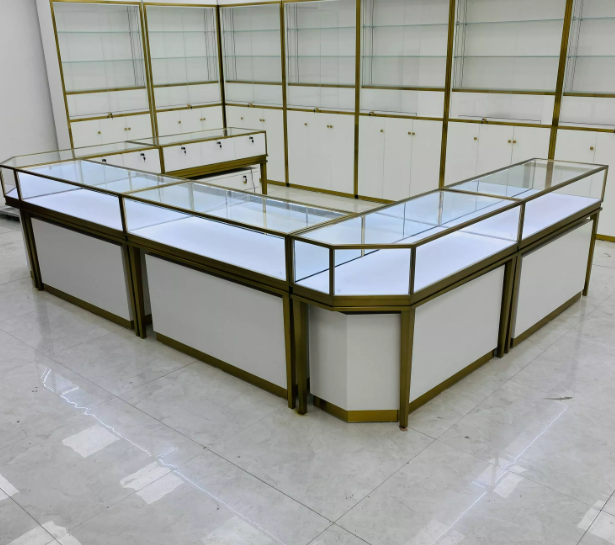
An "Extra Vision" case is defined by minimal vertical framing and maximum glass surface area. These units typically feature an aluminum skeleton that supports the glass without thick wooden corners. They offer a near 360-degree visibility profile.
These are best suited for high-volume retail environments where the product must be visible from every approach angle, such as in vape shops, gift shops, or center-aisle mall kiosks. The pro here is light entry; ambient store lighting penetrates deep into the case, reducing the need for intense internal illumination. However, they offer zero concealed storage.
The distinction between full and half vision usually comes down to inventory management.
Full Vision: These units typically feature two adjustable glass shelves and a glass top, maximizing the display area from the knee up. They are best for high-margin items where you want to show as much stock as possible.
Half Vision: These units feature a higher "kick base" or pedestal, often rising 18 to 24 inches from the floor. Behind this opaque base lies concealed storage. These are the superior choice for retailers who need immediate access to backup inventory, such as tech stores or dispensaries, without leaving the sales floor.
Space efficiency often dictates the use of vertical towers. These glass display cases utilize vertical dead space, making them ideal for corners. A 45-degree corner unit can bridge two linear runs of counters, turning a sharp turn into a smooth, sellable visual flow. Scalability is the main advantage here; modular systems allow you to add units over time. If you plan to expand your store or collection in 2027, buying a modular system now ensures you won't be hunting for a discontinued model later.
The debate between glass and acrylic is often settled by logistics and clarity requirements. Both materials have distinct physical properties that make them suitable for different environments.
| Feature | Tempered Glass | Acrylic (Plexiglass) |
|---|---|---|
| Impact Resistance | Moderate (Shatters into safe cubes) | High (17x stronger than glass) |
| Scratch Resistance | Superior (Hard surface) | Low (Micro-abrasions occur easily) |
| Optical Clarity | Standard has "green edge" tint | Excellent (Clear, no tint) |
| Weight | Heavy (Requires strong floors) | Light (~50% lighter) |
| Maintenance | Standard cleaners (Ammonia ok) | Specialized cleaners only |
Standard tempered glass contains iron oxide, which results in a noticeable green tint at the edges. While this is acceptable for general retail, it can distort the color fidelity of high-end jewelry or art. "Low-iron" glass solves this but commands a significant price premium. Acrylic, by contrast, offers 92% light transmission and zero edge tint, providing an optically pure viewing experience. However, owners must be vigilant about cleaning; using ammonia-based cleaners (like Windex) on acrylic will cause "crazing," a permanent clouding of the material.
If your display is in a high-traffic zone where bumps are inevitable, acrylic is the safer bet. It is roughly 17 times more impact-resistant than glass and is shatterproof. However, for scratch hardness, tempered glass is vastly superior. A glass counter can withstand years of keys, rings, and zippers dragging across it. Acrylic will develop a haze of micro-abrasions under similar abuse, requiring frequent polishing to maintain transparency.
Consider the logistics of installation. Acrylic cases are approximately 50% lighter than their glass counterparts. This reduces shipping costs and makes them easier to move during store reconfigurations. A commercial run of 5/8-inch thick glass cases requires heavy-duty floor support and professional movers to relocate.
Once the structure and material are chosen, the "active" features of the case determine its performance.
Lighting can make or break a sale. The standard LED strips included in budget cases often suffer from low Color Rendering Index (CRI), making vibrant items look washed out. For jewelry, art, and high-end collectibles, you should demand a CRI greater than 90. This ensures accurate color representation.
Heat management is equally vital. LED bars must run cool. If you are using a Bakery Display Cabinet, excess heat from lighting can melt icings or sweat chocolates. In the collector world, heat accelerates the degradation of plastics. Furthermore, the angle of illumination matters. Interior lighting should be placed at a 30-degree angle to illuminate the product without blinding the customer with direct glare or reflection off the front glass.
Security goes beyond the lock cylinder. While we recommend upgrading from standard cam locks to plunger locks, the physical structure of the case is often the weak point. Check the glass anchor points. Shelves should be secured to the frame, not just resting on pins. In "smash and grab" scenarios, loose shelves can be tipped forward to slide merchandise out. For high-value retail, smart locks with digital audit trails are becoming standard, allowing managers to see exactly who opened a case and when.
Light destroys. Ultraviolet (UV) rays will fade packaging on vintage toys and bleach the color from fabrics. UV-bonded glass or specially treated acrylic panels can block up to 98% of UV rays. This is an essential feature for preservation. Humidity control is generally a custom add-on, involving silica gel chambers for passive control or active micro-humidifiers for items like cigars or ancient parchment.
The sticker price of a display case is rarely the final cost. Experienced buyers analyze the Total Cost of Ownership (TCO), which includes freight, labor, and potential downtime.
Budget cases found on general marketplaces often ship via parcel services. To survive this, they are packed flat with minimal padding, leading to a high risk of breakage upon arrival. Commercial-grade units ship via LTL (Less Than Truckload) Freight. They arrive palletized and shrink-wrapped. While this ensures safety, it requires a loading dock or a lift-gate service, adding $200–$500 to the TCO. Ignoring this cost during budgeting is a common rookie mistake.
There is a distinct difference in rigidity between a flat-pack DIY kit and a factory-assembled unit. Cheap DIY kits often suffer from the "Wobble Factor," lacking the structural torque to remain rigid on uneven floors. Commercial units typically come pre-assembled or utilize heavy-duty steel and aluminum extrusion frames that bolt together for permanence. You must also calculate the time cost. Is it worth saving $100 on the purchase price if you lose four hours of staff time assembling a complex unit?
The high-end modular display market is currently plagued by long lead times. Popular brands often operate on a pre-order basis with waits extending 6 to 9 months. Retailers who need to open their doors next month cannot afford this delay. In these instances, prioritizing domestic suppliers with "In-Stock" inventory takes precedence over custom imports. Always verify the stock status before committing capital.
The ideal display case is not a generic box; it is a specialized tool matched to your inventory. If you are building a private museum or need shipping safety, Acrylic and Modular systems offer the best balance of protection and flexibility. For high-traffic retail environments where scratch resistance and volume are paramount, Tempered Glass Extra Vision units remain the industry standard. Finally, for operations requiring efficient stock rotation, the Half Vision profile provides the necessary operational storage.
Before purchasing, we strongly advise measuring your "access clearance." Ensure that drawers and doors have enough room to open fully without blocking aisles or hitting other fixtures. Your display case should enhance your workflow, not hinder it.
A: For heavy statues or dense inventory, avoid standard 1/4-inch glass. We recommend upgrading to 3/8-inch (approx. 10mm) tempered glass. This thickness significantly increases rigidity and reduces the risk of bowing or catastrophic failure under static loads. Always check the manufacturer’s specific weight rating per shelf before loading.
A: No. You should never use Windex or any ammonia-based cleaners on acrylic. Ammonia attacks the chemical bonds of the plastic, causing "crazing" (a network of fine cracks) and permanent cloudiness. Instead, use a specialized acrylic cleaner (like Novus) or a solution of mild dish soap and warm water with a microfiber cloth.
A: "Full Vision" typically refers to cases with two glass shelves and a wood or metal frame, maximizing vertical display space. "Extra Vision" usually implies an aluminum-framed unit with even less visual obstruction and a 360-degree glass view, often used to maximize light entry in retail aisles.
A: Most standard cabinets have gaps around the door hinges. To dust-proof them, apply adhesive weather stripping (brush or rubber seals) along the door edges. For high-end collections, creating positive air pressure inside the cabinet using a small filtered fan can actively push dust away from gaps.
A: Yes, provided they are high-quality LEDs. Unlike halogen bulbs, LEDs emit very little infrared heat and minimal UV radiation, making them safe for heat-sensitive bakery goods and vintage plastics. However, always ensure the LEDs have a proper heat sink to dissipate the small amount of heat they do generate.


