
Views: 0 Author: Site Editor Publish Time: 2026-07-07 Origin: Site


Retailers often view commercial display fixtures as simple aesthetic assets. You should treat them as critical capital expenditures. Lighting and clean glass certainly drive initial buyer psychology. Behind the scenes, underlying structural engineering dictates inventory security and daily operational reliability. A structurally sound Jewelry Display Cabinet prevents premature material fatigue. It actively mitigates environmental damage to your high-value inventory. Good engineering also ensures long-term operational stability on the sales floor. We avoid promising "future-proof" solutions here. Instead, we focus on measurable durability and practical risk mitigation. You will learn how load distribution, sealing tolerances, and material choices impact your retail infrastructure. Understanding these hidden mechanics transforms a standard procurement process into a strategic investment.
Load Distribution: Improper structural frameworks lead to micro-fractures in glass and hinge misalignment over a 3–5 year cycle.
Environmental Control: Precision structural sealing is required to manage internal microclimates (heat dissipation from LEDs, dust ingress, humidity).
Customization Risks: Scaling aesthetics without validating load-bearing physics often results in costly rollout failures.
Vendor Accountability: Evaluating a manufacturer requires auditing their structural testing protocols, not just their design portfolio.
Store environments create intense operational realities. High-traffic stores subject cabinets to daily repetitive stress. Staff open and close doors hundreds of times each week. Customers lean heavily on the top glass while examining watches or rings. Janitorial teams apply vigorous downward pressure during nightly cleaning. These continuous physical forces test the limits of your fixtures daily.
Success requires strict engineering criteria. A stable structural design must maintain zero-tolerance alignment for locks and hinges. This mechanical precision must last across tens of thousands of cycles. Even minor structural shifts cause major operational problems on the sales floor. You cannot rely on visual appeal alone when underlying physics dictate functionality.
Failure brings cascading consequences. Weak metal frames cause glass doors to sag. Misaligned doors immediately create severe security vulnerabilities. Thieves routinely exploit tiny gaps in loose locking mechanisms. Furthermore, gaps compromise internal seals. Moisture then enters the case and induces tarnish on sensitive metals like silver. Retailers ultimately face the direct expense of mid-lifecycle replacement. Reliable structural engineering prevents these operational disruptions entirely.
What to watch out for: Never ignore a door requiring extra lifting to lock. This indicates severe structural sagging. It means the base geometry is actively failing under the glass weight.
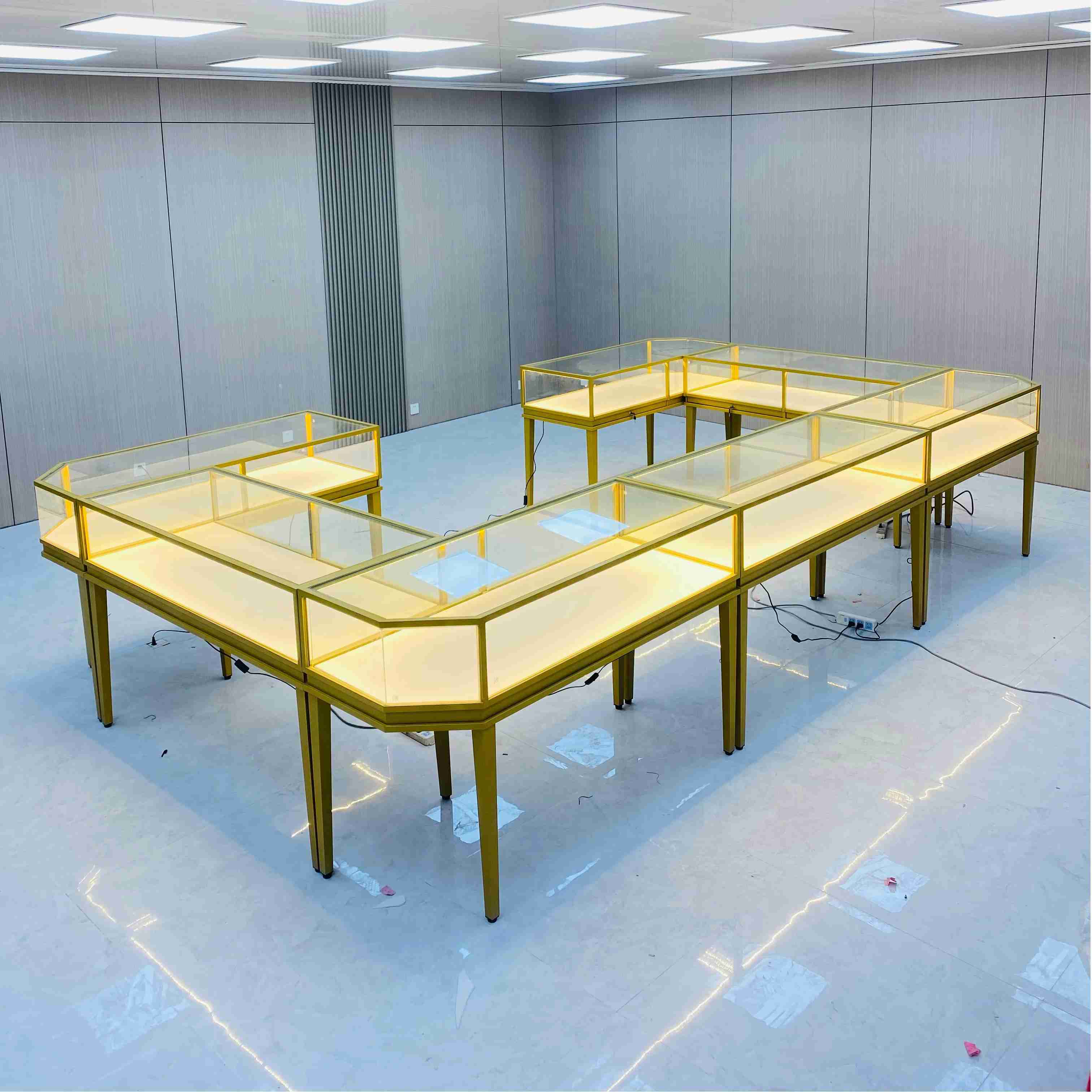
Every fixture needs a robust foundation. We must evaluate exactly how materials interact under continuous physical pressure.
Engineers typically connect glass to metal using either UV-bonding or mechanical framing. UV-bonded joints look completely seamless. They create the illusion of floating glass. Mechanical frames offer rugged visibility and extreme physical durability. Both methods face challenges from thermal expansion. Stainless steel and aluminum expand at different rates than glass. Proper engineering accounts for these physical changes. If designers ignore thermal variance, stress fractures will inevitably occur. Minor temperature swings in a mall environment can trigger this expansion rapidly.
The base structure must securely hold the heavy upper glass vitrine. Heavy-duty laminated glass adds immense weight. Therefore, you need heavily reinforced plinths. Strong plinths prevent center-sag over time. A weak base slowly bows inward under gravity. This bowing pulls the side panels out of alignment and risks sudden glass shattering.
Hinges and drawer glides require precise mechanical integration. Builders must anchor all hardware directly into the primary structural frame. Anchoring heavy hinges into secondary aesthetic panels leads to fast failure. The primary metal skeleton must absorb the kinetic energy of door movements.
Best Practice: Always ask your vendor to demonstrate how hinge backplates connect to the internal steel skeleton. They should never screw directly into exterior wood veneers.
Adhesion Method | Primary Benefit | Structural Vulnerability | Ideal Retail Use Case |
|---|---|---|---|
UV-Bonding | Creates a seamless aesthetic | Brittle under extreme thermal shifts | Climate-controlled luxury floors |
Mechanical Framing | Provides maximum load capacity | Visible joints and mechanical screws | High-traffic or security-heavy zones |
Structural integrity also defines how well a cabinet protects its contents from the external environment.
Internal LED lighting generates trapped heat. Structural designs must include passive or active heat sinks. Excessive heat accelerates the degradation of delicate display fabrics like velvet or suede. Trapped heat can also impact specific gemstones. For example, opals and heavily oiled emeralds require stable, cool environments. Otherwise, they risk cracking or rapid discoloration.
A strong frame enables precision sealing. Dust-proofing and humidity control rely entirely on this exact science. Standard commercial sealing keeps out basic dust. Museum-grade conservation sealing creates high-end archival stability for extremely valuable pieces.
Attaining a near-airtight seal demands rigid structural tolerances. Even a tiny flaw destroys the physical barrier.
Thermal Dissipation Routing: Internal vents or aluminum heat sinks draw heat away from the display deck safely.
Dust Ingress Prevention: Silicone gaskets remain compressed only if the metal frame stays perfectly square over its lifetime.
Humidity Management Zones: Archival silica gel compartments require flawless airtight seals to function properly over months.
Contaminant Outgassing: High-quality structural adhesives must cure fully to prevent internal chemical outgassing.
A single 1 millimeter warp in the metal frame compromises the entire microclimate. The physical structure literally dictates the internal environment.
Translating a digital render into physical reality carries distinct rollout risks. A design might work flawlessly as a single prototype. However, it may fail when you scale it into modular, interconnected runs. Engineering a custom Jewelry Display Cabinet requires rigorous physical testing before broad regional deployment.
Store environments introduce unpredictable site-specific variables. Older retail spaces rarely have perfectly level floors. Historic buildings often feature subtle slopes. Adjustable structural feet must handle this uneven load distribution. If the feet fail, the frame twists. Twisting inevitably shatters the expensive glass panels above.
Retailers must also consider weight constraints carefully. Store managers need to respect ADA (Americans with Disabilities Act) compliance. Overhangs must not become dangerous tipping hazards. You must plan for these structural variables early in the design phase.
Check the floor level variance across the entire intended cabinet run.
Calculate total structural weight to ensure compliance with local flooring load limits.
Design the base footprint securely to prevent any forward tipping risk.
Verify compliance rules ensuring ADA clearance heights do not compromise internal structural supports.
Finally, shipping and assembly present major physical hurdles. The best structural design remains useless if it shatters during freight transport. Monolithic, fully welded structures offer immense strength. Yet, they cost significantly more to ship and navigate through narrow doors. Modular assembly components ship flat but require precise on-site bolting. You must balance transport physics against ultimate retail floor durability.
Finding a reliable partner differs greatly from hiring a mere fabricator. An excellent Display Cabinet Manufacturer views projects through a strict engineering lens. They prioritize load distribution over pure aesthetics.
Credible manufacturers insist on physical prototyping. They rigorously test load limits, lighting heat generation, and hardware fatigue long before mass production begins. A cheap fabricator might skip this crucial step entirely to save money. You should never accept theoretical digital tests alone. Real-world stress testing reveals hidden mechanical flaws.
You must also read the manufacturer warranty carefully. Look for clear service level agreements. Reliable vendors guarantee their structural welds. They cover UV-bonded joints against separation. They do not just guarantee easily replaceable lighting components. If a vendor refuses to warranty the frame against sagging, you should look elsewhere.
Use this technical checklist during your Request for Proposal (RFP) stage to ensure strict vendor accountability:
Specification Requirement | Acceptable Baseline Standard |
|---|---|
Glass Weight Limits | Tested securely for 2x actual operational load |
Hinge Cycle Ratings | Minimum 50,000 open/close verified cycles |
Base Material Thickness | Specified in exact steel gauge, not generic terms |
Seal Tolerance Check | Documented physical testing for structural deflection |
Heat Dissipation Audit | Thermal imaging reports for full LED activation |
A structurally sound jewelry display cabinet acts as a calculated risk management tool. It does far more than hold products elegantly. Aesthetics certainly attract the customer to the counter initially. However, structural design protects the high-value asset inside. Proper engineering guarantees your physical investment survives over a decade of heavy retail use.
Take action today by reviewing your current vendor engineering standards. Request a technical consultation or a structural specification sheet from your internal team. Evaluate your current or future store fixtures rigorously against load-bearing physics. Demand physical prototypes and strict load-testing documentation before authorizing a broad rollout. Secure your inventory completely by demanding excellence in every unseen weld and hidden joint.
A: Laminated security glass is significantly heavier than standard tempered glass. This added weight demands a highly reinforced structural base. It also requires heavy-duty, commercial-grade hinges to prevent door sagging. A weak frame cannot support laminated panels safely over time.
A: A structurally optimized frame usually lasts 10 to 15 years or more. You will likely need to refresh lighting and hardware every 5 to 7 years. In contrast, cheaper units often fail within 3 years due to joint fatigue and warping.
A: Reliable builders construct full physical prototypes. They perform accelerated wear testing on all hinges and locks. They also use thermal imaging to verify proper LED heat dissipation. This ensures the frame safely manages weight and environmental factors.
A: Usually no. High-security locks and heavy-duty glass require a foundation built to handle the intense structural load. If you attempt to retrofit a weak frame, it often leads to glass cracking, hinge failure, or immediate structural collapse.


