
Views: 0 Author: Site Editor Publish Time: 2026-07-02 Origin: Site


The jewelry industry is witnessing a profound consumption upgrade right before our eyes. Shoppers no longer arrive just to make transactional purchases. Instead, they seek deep, brand-immersive retail experiences. This shift reveals a major problem for older store formats. Traditional floor plans simply fail to capture this new dynamic. Today, spatial logic revolves around the micro-architecture of the retail environment itself. Every physical touchpoint dictates how customers feel, interact, and ultimately purchase.
The modern Jewelry Display Cabinet stands out as the primary mediator of this upgraded experience. It perfectly balances high-end aesthetics with stringent, invisible security. In this guide, we provide a complete framework for retail directors and procurement teams. You will learn how to evaluate, shortlist, and implement advanced display solutions. Read on to discover strategies to align your physical assets with modern consumer psychology and elevate your retail success.
Spatial Shift: Modern jewelry retail requires display units that facilitate side-by-side consultation rather than traditional over-the-counter separation.
Evaluation Criteria: High-performance cabinets must be assessed on glass clarity (low-iron), lighting accuracy (CRI > 95), and integrated security without visual bulk.
Customization ROI: A custom jewelry display cabinet offers superior alignment with spatial flow and brand identity, though it requires rigorous prototyping and longer lead times.
Vendor Selection: Shortlisting a display cabinet manufacturer demands auditing their engineering capabilities, material sourcing transparency, and post-installation support.
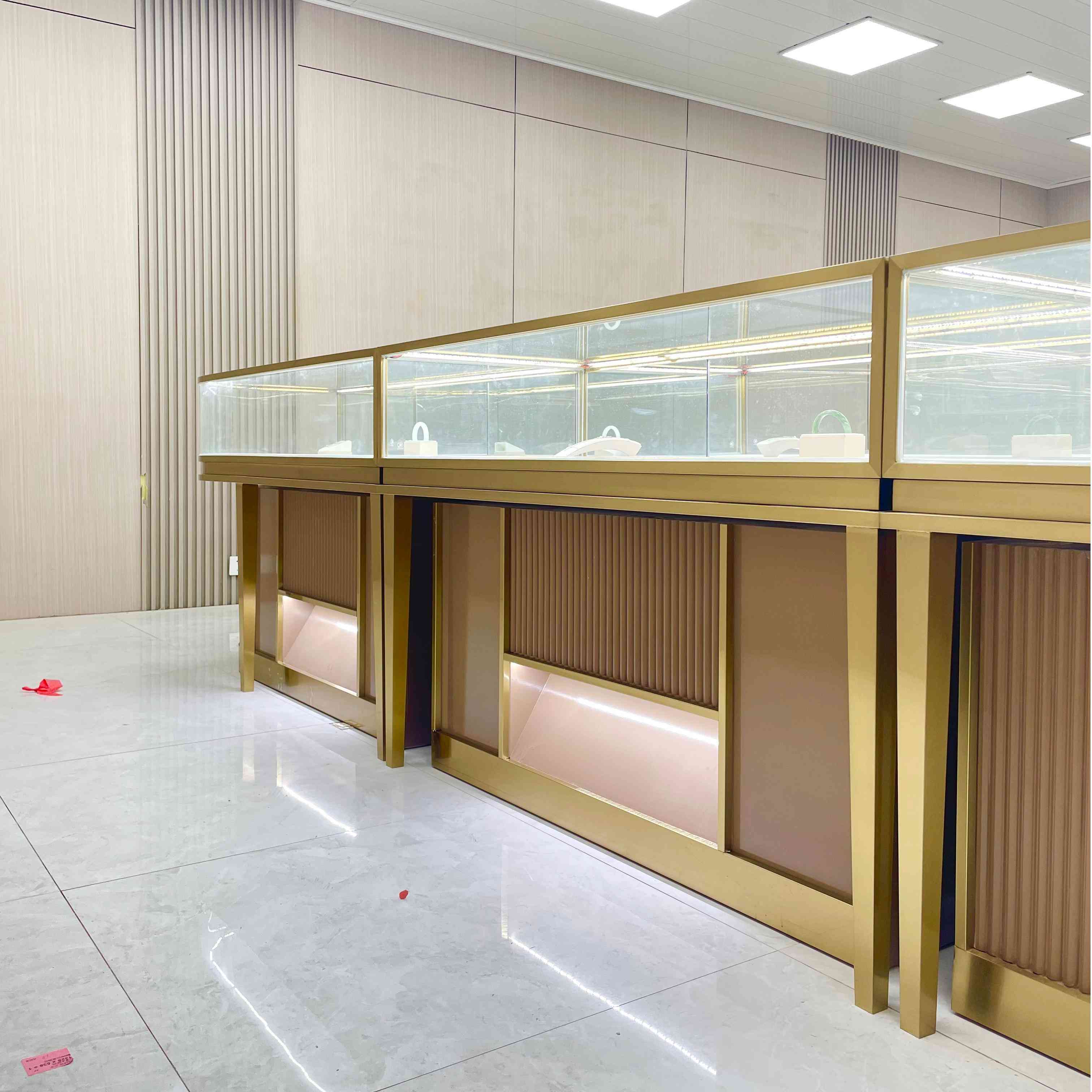
Luxury consumers now expect highly interactive and frictionless environments. They want to explore collections without feeling intimidated. Traditional bulky, barrier-style counters actively disrupt the psychological flow of modern spatial logic. These old structures place the staff on one side and the customer on the other. This creates an adversarial, transactional dynamic. Modern retail requires a collaborative layout. We must remove these physical barriers to foster trust and encourage longer dwell times.
You cannot achieve this spatial shift without updating your physical assets. Upgraded retail environments demand specific success criteria for every display unit. Merchandising teams must look beyond simple storage. They must treat these units as active sales tools. When evaluating new assets, we measure success across three vital dimensions.
Visual Merchandising ROI: You must maximize product visibility per square foot. Clutter kills luxury. The best designs use minimalist internal staging to highlight fewer pieces with greater impact. This elevates the perceived value of each item.
Security-to-Aesthetic Ratio: High-grade security remains absolutely non-negotiable. However, it must remain invisible to the shopper. Tamper-proof locks and integrated alarms should hide seamlessly within elegant metal frames. The customer should only see the art, never the vault.
Consultative Ergonomics: The physical dimensions dictate the sales interaction. Heights and depths must allow sales staff to stand comfortably beside the customer. This side-by-side alignment fosters collaboration. It transforms a sales pitch into a shared discovery process.
Retail teams face a critical decision when upgrading their environments. They must choose between off-the-shelf units and highly tailored solutions. Each path carries specific strategic implications for the brand.
Standardized or modular cabinets offer several clear advantages. You can deploy them quickly across multiple locations. They provide predictable timelines and proven structural integrity. Engineers have already tested these units for everyday wear and tear. However, standardized units come with significant drawbacks. They impose rigid spatial footprints. You might find it difficult to align generic cabinets with unique brand architectures. They often fall short in premium flagship store designs where every millimeter matters.
Choosing a custom Jewelry Display Cabinet unlocks immense strategic value. You gain the power to tailor dimensions, material finishes, and internal lighting. You can match these elements to specific store zoning. For example, you can design an intimate, warmly lit cabinet for bridal collections. A few feet away, you can install a bold, brightly lit island for high jewelry. This approach ensures perfect alignment with your brand identity. You must also factor in localized compliance requirements during the prototyping phases. Custom engineering ensures your units meet regional safety standards while preserving your design vision.
Feature Dimension | Standardized Modular Cabinets | Custom Display Approach |
|---|---|---|
Deployment Speed | Fast (2-4 weeks). Ready to ship. | Slower (8-12 weeks). Requires engineering. |
Spatial Flexibility | Rigid. Fixed footprints and heights. | High. Adapts to awkward columns and corners. |
Brand Alignment | Generic. Limited finish options. | Exact. Matches flagship architectural guidelines. |
Zoning Capability | Uniform lighting across all units. | Tailored lighting for specific gemstone types. |
Evaluating retail display units requires strict technical scrutiny. You cannot base procurement decisions on aesthetics alone. The underlying engineering determines the longevity, safety, and visual performance of the asset.
Glass selection serves as the most critical visual component. You must mandate ultra-clear, low-iron tempered or laminated glass. Standard glass contains iron impurities. These impurities create a slight green tint along the edges. This green hue distorts the true color of diamonds and precious metals. Low-iron glass eliminates this distortion. Furthermore, laminated security glass ensures shatter resistance. It prevents grab-and-run thefts while maintaining perfect transparency.
Frame engineering provides the skeleton of the unit. Retailers often choose between stainless steel, brass, or aerospace-grade aluminum. We recommend PVD-coated stainless steel for high-traffic areas. It resists daily wear, scratching, and oxidation much better than raw brass. Aluminum offers a lightweight alternative, but it must be heavily anodized to prevent dulling over time.
Modern merchandising moves far beyond mere brightness. You must evaluate the Color Rendering Index (CRI). A CRI above 95 ensures gemstones display their true, vibrant colors. Precise color temperature, measured in Kelvin (K), is equally vital. You must tailor the temperature to the specific merchandise.
Gemstone / Material Type | Ideal Color Temperature (Kelvin) | Visual Effect |
|---|---|---|
Diamonds & Platinum | 4000K - 4500K | Enhances brilliance and stark white flashes. |
Gold & Warm Stones (Rubies) | 3000K - 3500K | Enriches deep yellow and red undertones. |
Jade & Emeralds | 3500K - 4000K | Balances green saturation without washing out. |
Additionally, you must implement robust heat dissipation systems. High-intensity LEDs generate internal heat. Without proper heat sinks, this trapped heat damages sensitive materials like pearls, opals, and velvet display pads. Excellent thermal management also extends the lifespan of the lighting hardware.
Security mechanisms must evolve alongside spatial logic. Mechanical keyholes disrupt clean architectural lines. Today, you should assess concealed RFID locks and biometric access systems. These invisible locks allow staff to open cases seamlessly using a badge or fingerprint. This keeps the customer focused on the jewelry, not the security protocol.
You also need to evaluate the physical opening mechanics. Hydraulic lifting mechanisms or smooth-glide tracks are essential. They ensure daily operational efficiency. A heavy glass hood should open effortlessly with one hand. If staff struggle to open a heavy case, the luxury illusion shatters instantly.
Procuring new physical assets involves significant logistical hurdles. Many retail directors underestimate the complexity of a global store rollout. You must anticipate these implementation realities to prevent costly delays.
Lead Time Realities: You must acknowledge the typical 8 to 12-week timeline for bespoke units. This window covers custom engineering, raw material sourcing, manufacturing, and global shipping. Rushing this process usually results in poor glass alignment or failing smart locks.
Site Prep and Floor Constraints: Custom units often feature heavy security glass and solid stone bases. You must verify the floor load-bearing limits of your retail space. Putting a 500-pound unit on a raised hollow floor creates severe structural risks.
Electrical Routing Plans: Modern cabinets require constant power for LEDs and RFID locks. You must execute precise floor-core planning before the cabinets arrive. Hidden wiring must route directly into the base of the unit. Exposed cables instantly destroy the high-end aesthetic.
Long-Term Maintenance Assumptions: Document the lifecycle of every moving part. You will need to replace LED drivers over a 5 to 10-year period. Repairing smart locks requires accessible service panels. Specialized metal finishes will need periodic professional polishing to maintain their luster.
By mapping out these hurdles early, procurement teams can align with general contractors. This ensures the physical site is perfectly prepped the moment the shipping crates arrive.
Choosing the right fabrication partner carries immense risk. You are not just buying furniture; you are investing in secure micro-architecture. You must vet a potential Display Cabinet Manufacturer using strict, evidence-based criteria.
First, demand proof of their engineering and prototyping capabilities. A reputable vendor will provide detailed 3D modeling and structural stress testing reports. They must possess the ability to produce a fully functional 1:1 prototype before beginning mass production. This prototype phase allows you to test the lighting angles, lock responsiveness, and ergonomic height in the real world. Skipping the prototype stage is a common mistake that leads to massive fleet-wide failures.
Second, verify their supply chain transparency and compliance. Mall operators and local fire marshals require strict electrical certifications. You must ensure the vendor holds CE, UL, or regional equivalent certifications for all lighting components. Furthermore, luxury brands face increasing scrutiny regarding ethical sourcing. Ask the vendor to prove their material sourcing ethics, especially concerning exotic woods, leathers, and conflict-free metals.
Finally, evaluate their global logistics and post-sales support networks. A great manufacturer does not disappear after the crates leave their dock. Evaluate their track record with international shipping and complex customs documentation. Ask about their localized maintenance partnerships. If an RFID lock fails in London, you need a local technician who can source replacement parts quickly. Excellent post-sales support ensures your retail environment remains flawless year after year.
The modern jewelry display cabinet plays a highly strategic role in retail today. It perfectly executes the spatial logic required for luxury consumption upgrading. These units are no longer just storage boxes. They are the primary physical touchpoints that mediate the entire customer journey.
Making the right investment requires a delicate balancing act. You must merge aesthetic brand alignment with uncompromising security and consultative ergonomics. When you remove physical barriers, you invite customers into a shared experience. When you engineer perfect lighting, you maximize the emotional impact of every gemstone.
Take action today to modernize your retail environments. We recommend initiating your procurement process immediately. Start by requesting technical specification sheets from a vetted manufacturing partner. Draft your requirements for low-iron glass, CRI ratings, and biometric security. Then, commission a pilot prototype. This hands-on approach will guarantee your physical spaces match the elevated expectations of the modern luxury consumer.
A: A fully custom unit typically requires 8 to 12 weeks. This includes 2 weeks for 3D design and engineering, 3-4 weeks for prototyping, and 3-4 weeks for mass production. Freight shipping adds extra time depending on global routing.
A: Base your lighting on the gemstone type. Always use a Color Rendering Index (CRI) above 95. Use 4000K-4500K for diamonds to enhance white brilliance. Use 3000K-3500K for gold and warm stones to enrich their deep undertones.
A: Your RFP must detail strict technical requirements. Include low-iron glass specifications, desired lock types (RFID or biometric), structural material grades (e.g., PVD stainless steel), UL/CE electrical certifications, and explicit 5-10 year warranty expectations for moving parts.
A: Yes, modern smart locks are highly reliable if engineered correctly. However, you must insist on systems with built-in battery backups. You also need a manual mechanical override keyway to ensure access during total power or systemic failures.


