
Views: 0 Author: Site Editor Publish Time: 2026-09-02 Origin: Site


The operational reality of frozen dessert retail is unforgiving. Product visibility drives your sales, but slight temperature fluctuations destroy product texture, leading to immediate revenue loss. You cannot sell crystallized, heat-shocked ice cream. Balancing high-visibility merchandising with strict thermal stability is the core challenge every operator faces. Display units inherently expose products to ambient heat through glass panels. Your equipment must counteract this heat intrusion while maintaining energy efficiency.
Selecting the right unit requires moving beyond basic aesthetics. You need a technical evaluation framework. This framework must analyze your specific service model, spatial constraints, and daily capacity requirements. You must understand how compressor placement, glass technology, and airflow dynamics interact on your sales floor. This guide breaks down the engineering and operational factors you must evaluate before making an equipment decision.
Thermal Stability is Paramount: Maintaining temperatures between -10°F and -20°F requires evaluating compressor placement, insulation thickness, and defrost mechanisms over mere aesthetics.
Form Factor Dictates Function: The choice between an upright unit, a chest freezer, or a dipping cabinet must align strictly with your inventory type (pre-packaged vs. scooped), floor traffic flow, and target demographic accessibility.
Glass Technology Impacts Energy Costs: Anti-condensation features and Low-E glass prevent frost buildup and reduce the load on the compressor, directly impacting long-term energy costs.
Vendor Reliability Matters: Sourcing from a reputable ice cream display cabinet manufacturer ensures access to replacement parts, warranty fulfillment, and technical support.
Before looking at specific models, you must define what success looks like for your operation. A commercial ice cream display cabinet must perform three distinct jobs simultaneously. It must protect the product, sell the product, and facilitate efficient service. Failing in any of these areas disrupts your daily operations and degrades the customer experience.
Different frozen desserts require vastly different holding environments. The butterfat content, sugar levels, and overrun (the amount of air whipped into the product) dictate the exact freezing point. Traditional hard ice cream demands holding temperatures between -10°F and -20°F. This deep freeze maintains the structural integrity of the butterfat and prevents melting. Gelato requires a warmer environment, typically between 10°F and 15°F. This warmer range keeps the dense, low-air mixture soft enough to spade. Frozen novelties and popsicles usually sit comfortably at -10°F.
Temperature fluctuations cause heat shock. When cabinet temperatures rise, microscopic ice crystals melt. When the compressor kicks back on and temperatures drop, that water refreezes into larger, jagged ice crystals. This ruins the smooth mouthfeel of the product, leaving a gritty texture. Heat shock occurs due to inadequate cooling cycles, degraded insulation, or operators over-packing the cabinet past the load line. Your commercial ice cream display freezer must have the cooling capacity to recover rapidly after doors or lids are opened.
Product Type | Ideal Holding Temperature | Air Content (Overrun) | Primary Spoilage Risk |
|---|---|---|---|
Hard Ice Cream | -10°F to -20°F | 30% - 50% | Heat shock (crystallization) |
Gelato | 10°F to 15°F | 20% - 30% | Melting and separation |
Sorbet / Italian Ice | 5°F to 10°F | 10% - 20% | Syrup pooling at the bottom |
Frozen Novelties | -10°F to -15°F | Varies | Frost buildup on packaging |
Customers eat with their eyes first. Product visibility metrics directly correlate with impulse purchase rates. You must evaluate the total glass surface area and the angles of interior lighting. High visibility means the product catches the customer's eye from across the room. Glass is a poor insulator compared to solid polyurethane walls, meaning you must balance the need for expansive glass with the thermodynamic reality of keeping the interior freezing cold.
Case height and sightlines require careful consideration. If your target demographic includes children, a tall cabinet creates a physical barrier. Lower profiles work best in scoop shops where kids want to point at their favorite flavors. The cabinet design must frame the product without creating glare from overhead store lighting. Lighting quality also matters. You need LED fixtures with a Color Rendering Index (CRI) above 90 to ensure fruit sorbets look vibrant and chocolate flavors look rich, rather than washed out.
Service-based models rely on speed. Your staff must access the product quickly and safely. Ergonomic scooping heights prevent repetitive strain injuries during busy summer shifts. The standard counter height is 36 inches, but you must also consider ADA compliance, which often requires a maximum height of 34 inches for accessible service counters. The distance from the front glass to the back row of tubs dictates how far employees must reach. Deep cabinets maximize capacity but strain workers.
Verify the reach depth from the operator side to the furthest tub to ensure staff do not have to lean heavily against the glass.
Check for removable tub skirts that catch drips and prevent spilled product from falling into the lower refrigeration compartment.
Ensure the unit features an accessible floor drain plug to facilitate rapid washdowns at the end of the shift.
Test the weight and glide of sliding rear doors to confirm they will not slow down service during peak hours.
Form factor dictates function. You cannot force a grab-and-go freezer into a scoop shop workflow. You must match the physical design of the equipment to your inventory type, floor traffic patterns, and available square footage.
Dipping cabinets serve as the focal point for scoop shops, cafes, and parlors. These units hold bulk tubs open for immediate service. The operator stands behind the unit, while the customer views the product through a front glass shield. This setup facilitates interaction and sampling. You must ensure the cabinet holds enough facing flavors to attract customers while providing adequate backup storage underneath the display tier.
Many operators prefer a curved glass ice cream display freezer over flat glass models. Curved glass reduces overhead lighting glare. It provides better customer sightlines into the front row of tubs. The sweeping profile also offers a modern aesthetic that elevates the perceived value of the dessert. These cases often include rear storage compartments for backup tubs, allowing staff to swap empty flavors without leaving the service counter.
High-volume retail and convenience stores require vertical merchandising. An upright ice cream display freezer maximizes the footprint-to-capacity ratio. It utilizes vertical airspace rather than consuming valuable floor space. These units hold pre-packaged pints, quarts, and novelties, making them ideal for self-service environments.
Vertical configurations face significant thermal challenges. Cold air is heavy and falls out of the cabinet every time a customer opens the door. Therefore, torsion-spring auto-closing doors are mandatory. Heated glass is also necessary to prevent condensation from forming on the vertical panes during high-traffic periods. Heavy-duty, adjustable shelving ensures you can configure the interior for different packaging sizes without wasting vertical space. You must also account for the door swing radius when planning your aisle widths.
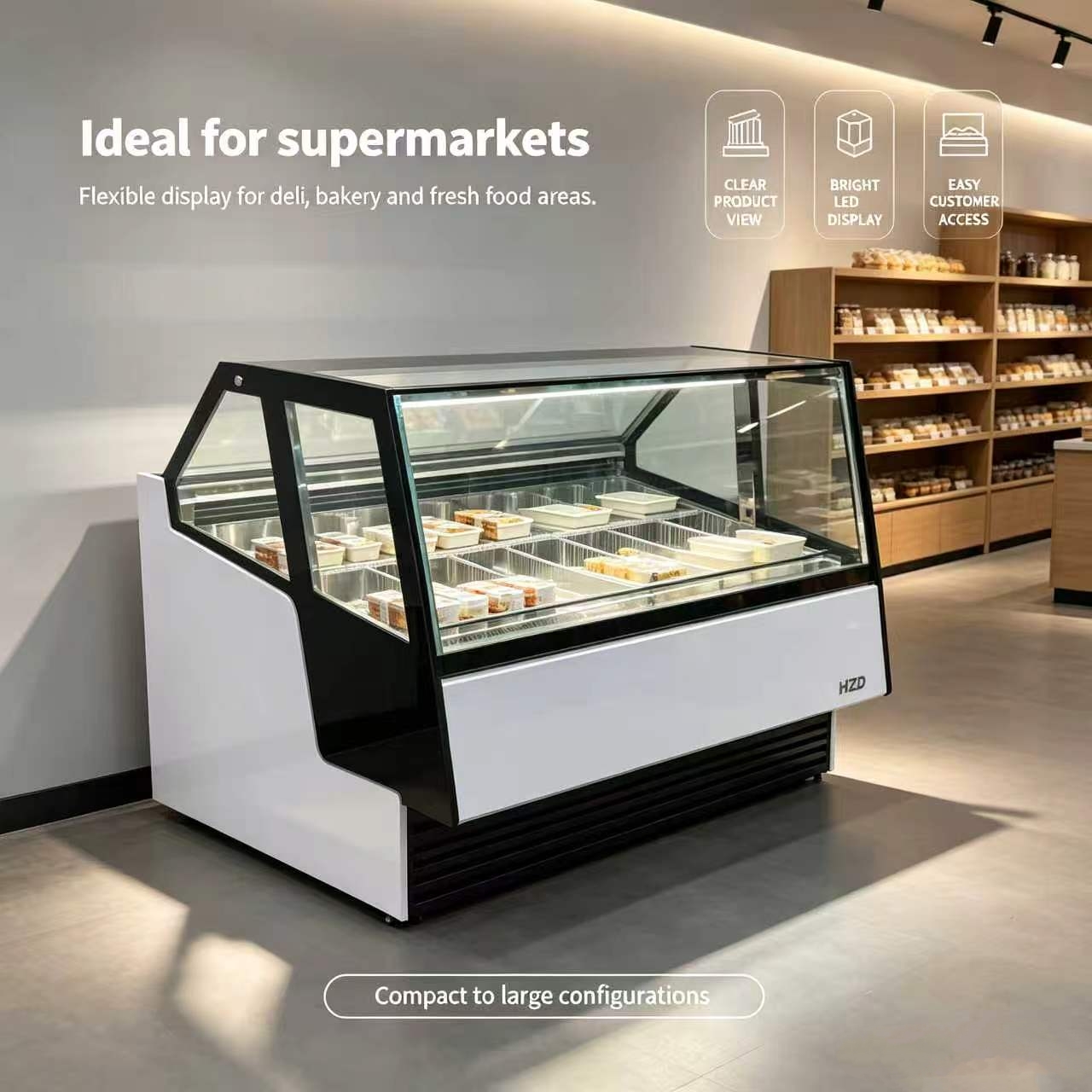
Large-scale retail environments demand high-capacity bulk storage. A supermarket ice cream display case often takes the form of a wide-aisle bunker or an island freezer. These units allow multiple customers to shop simultaneously from different sides, preventing bottlenecks in busy grocery aisles.
Supermarket cases frequently feature dual-temperature capabilities, allowing operators to switch between medium temp (for meats or dairy) and low temp (for frozen desserts) based on seasonal demand. Sliding glass lid efficiencies are critical here. The lids keep the heavy cold air trapped inside while still offering top-down visibility. These units often utilize multiplexing, where several cases connect to a single remote refrigeration rack located on the roof or in a back room. This removes compressor heat and noise from the sales floor entirely.
Glass lid chest freezers serve as the baseline solution for pre-packaged novelties. They fit well in space-constrained environments or locations where frozen desserts are a secondary revenue stream. You will typically find these near the Point-of-Sale (POS) or in forecourt placements to maximize impulse buys while customers wait in line.
These units offer low upfront implementation barriers. However, they limit visibility to a top-down angle. Customers must stand directly over the unit to see the bottom layers. Integrated security locks are a vital feature for these models, especially if they sit near exits or in 24-hour convenience settings. Wire baskets and dividers help organize the interior, preventing smaller novelties from becoming buried at the bottom and damaged by heavier items.
Beneath the glass and stainless steel, commercial freezers rely on complex thermodynamic systems. Evaluating these technical components ensures your equipment can handle the ambient conditions of your specific facility. A refrigerated ice cream display cabinet must fight a constant battle against the heat and humidity of the surrounding room.
The method used to distribute cold air inside the cabinet drastically impacts product quality and operational routines. You must choose between static and ventilated systems based on your specific product type and foot traffic.
Static cooling relies on natural convection. Cold air radiates from the walls or gravity coils and settles over the product. This method causes less dehydration, making it ideal for unpackaged gelato or ice cream displayed in high, decorative mounds. However, static systems can develop uneven temperature zones. The top layer of the product may be softer than the bottom layer, requiring staff to manage the product carefully.
Ventilated (forced-air) cooling uses fans to circulate cold air actively throughout the cabinet. This ensures uniform temperatures across all tubs. Ventilated systems offer rapid temperature recovery after door openings, making them superior for high-volume shops. The downside is that the constant airflow accelerates product dehydration. You must cover tubs overnight in a ventilated cabinet to prevent the surface of the ice cream from drying out and forming a tough, unappealing skin.
Feature | Static Cooling | Ventilated (Forced-Air) Cooling |
|---|---|---|
Air Distribution | Natural convection (gravity) | Active fan circulation |
Temperature Uniformity | Prone to minor stratification | Highly consistent throughout |
Product Dehydration | Low (ideal for exposed mounds) | High (requires overnight covering) |
Recovery Time | Slower after door/lid openings | Rapid recovery during busy shifts |
Best Application | Artisanal gelato, low-traffic cafes | High-volume scoop shops, retail |
The compressor acts as the engine of your freezer. Its placement affects maintenance and performance. Bottom-mounted compressors pull cooler air from near the floor. This makes them efficient, and they raise the bottom shelf to an ergonomic height. They are also easier for technicians to access for routine cleaning. Top-mounted compressors pull warmer air from near the ceiling but intake less floor dust and debris. Top mounts are common in upright units to maximize lower display space.
Insulation traps the cold. You must look for high-density polyurethane insulation. Thick walls create a robust thermal barrier against ambient heat. The industry standard requires at least 2 to 2.5 inches of foamed-in-place polyurethane. Thinner walls force the compressor to run constantly, burning out the motor prematurely.
Refrigerant choice also matters. Modern equipment utilizes eco-friendly hydrocarbon refrigerants, specifically R290 (propane). R290 offers superior thermodynamic performance compared to older HFCs. It absorbs and releases heat more efficiently, reducing the workload on the compressor and extending the lifespan of the equipment. It also complies with strict environmental regulations regarding Global Warming Potential (GWP).
Condensation is the enemy of visual merchandising. When warm, humid ambient air hits the freezing cold glass, water droplets form. This obscures the product and ruins visibility. Manufacturers combat this using advanced glass technologies.
Low-E (low emissivity) glass features a microscopic coating that reflects ambient heat away from the cabinet while keeping the cold energy inside. Many units also use double or triple-pane glass filled with Argon gas, which acts as an invisible insulation layer. For high-humidity environments, heated glass panes are necessary. These panes feature a conductive wire mesh that gently warms the exterior surface of the glass. This keeps the glass temperature above the ambient dew point, entirely preventing condensation buildup even in coastal or humid climates.
Lighting transforms a basic freezer into an active merchandising tool. LED lighting is the standard. LEDs emit virtually no heat, which protects the product from localized melting. They also offer high lumen output, making colors pop. You should look for lighting positioned at the front of the cabinet, angling back toward the product, rather than lighting that shines straight down and creates shadows.
Capacity planning requires matching the internal volume directly to your daily sales velocity. Do not buy a massive cabinet if you only sell a few tubs a week. Running a half-empty freezer wastes energy and forces the compressor to work harder, as frozen product helps hold the cold mass inside the unit. Conversely, undersizing leads to frequent stockouts and frustrated customers.
Determine your tub standards before purchasing. North American operators typically use standard 3-gallon round tubs.
European-style gelato relies on rectangular 5-liter Napoli pans.
Ensure the cabinet's internal racking system supports your specific container shape without leaving wide, inefficient gaps.
For upright models, ensure the shelving is heavy-duty, epoxy-coated, and adjustable to accommodate varying box heights without bowing under the weight.
The physical construction of your freezer determines how it withstands the daily abuse of a commercial environment. You must evaluate the materials used and the support network behind the equipment to understand your true operating costs over the next decade.
Interior materials face constant exposure to moisture, metal scoops, and acidic cleaning chemicals. Stainless steel interiors offer the highest durability. Specifically, 304-grade stainless steel resists corrosion, does not dent easily, and cleans up rapidly. Painted aluminum or galvanized steel interiors represent a lower initial barrier to entry but are prone to scratching. Once the paint scratches, moisture penetrates the metal, leading to rust, flaking, and eventual structural failure.
Exterior construction also matters. High-traffic areas require robust bumpers and scratch-resistant side panels. The hinges on upright doors and the tracks on sliding lids must utilize heavy-duty commercial-grade plastics or metals. Weak hinges will sag over time, breaking the magnetic gasket seal and allowing warm air to flood the cabinet. Replacing a burned-out compressor due to a sagging door hinge is an entirely preventable expense.
Equipment goes down. When it does, your response time dictates your product loss. Sourcing from a reliable ice cream display cabinet manufacturer is critical. You must evaluate their warranty structures. Industry standards typically offer a five-year warranty on the compressor and a separate, one-to-three-year warranty for parts and labor.
Check the availability of OEM (Original Equipment Manufacturer) replacement parts. If a door gasket tears or a fan motor burns out, you cannot wait weeks for a proprietary part to ship overseas. Ensure the manufacturer has a robust domestic distribution network. Furthermore, verify that local refrigeration technicians are willing and able to service that specific brand. Buying an obscure brand saves money upfront but costs thousands in lost product when local techs refuse to work on it.
Buying the right equipment is only half the battle. Installing it incorrectly will void your warranty and destroy the compressor within months. You must prepare your facility and train your staff on proper operational protocols.
Compressors generate significant heat. They must breathe. If you push a freezer flush against a wall or pack boxes tightly around the base, the compressor cannot expel hot air. It will choke on its own exhaust, leading to rapid overheating and mechanical failure.
Failing to meet minimum clearance requirements is the leading cause of premature compressor burnout. Most manufacturers require 2 to 4 inches of clearance at the back and sides of the unit. You must measure your floor space accurately, factoring in these clearance zones. Ensure the intake louvers remain completely unobstructed at all times. Do not place the freezer directly next to ovens, fryers, or south-facing windows that generate excessive ambient heat.
Commercial freezers draw substantial amperage, especially during the initial startup phase when the compressor kicks on. You must never plug a commercial freezer into a shared electrical circuit. If the freezer shares a breaker with a blender, a POS system, or an espresso machine, the combined amp draw will trip the breaker. Your freezer will shut off, and your product will melt overnight.
Verify the voltage requirements before ordering. Smaller units run on standard 115V outlets. Larger supermarket cases or multi-door uprights often require 208/230V electrical service. You will likely need an electrician to install specific NEMA-rated receptacles (such as a NEMA L14-20P locking plug) to match the equipment's plug configuration and ensure a secure, uninterrupted power connection.
Routine maintenance keeps the equipment running efficiently. The condenser coil acts as the lungs of the freezer. It pulls in ambient air to cool the refrigerant. In a commercial setting, this coil quickly clogs with dust, flour, and grease. You must implement a strict protocol to clean this component.
Disconnect power to the unit before performing any maintenance.
Remove the front or rear louvered panel to access the condenser coil.
Use a stiff bristle brush to loosen caked-on dust, brushing strictly in the direction of the fins to avoid bending them.
Use a shop vacuum with a brush attachment to remove the debris completely.
Restore power and verify the condenser fan is spinning freely.
You must also manage defrost cycles. Automatic defrost systems use internal heaters to melt frost off the evaporator coils periodically. You must ensure the defrost timer aligns with your closed hours, as cabinet temperatures rise slightly during this cycle. Manual defrost cabinets require staff to empty the unit, unplug it, and physically melt the ice buildup. Failure to execute defrost protocols leads to evaporator freeze-ups, completely halting the cooling process.
Measure your available floor space and map out a strict 4-inch ventilation clearance zone around the proposed installation site to protect the compressor.
Audit your electrical panel with a licensed technician to confirm the availability of dedicated 115V or 208/230V circuits with appropriate NEMA receptacles.
Document your daily peak foot traffic to determine if you require forced-air cooling for rapid temperature recovery or static cooling for exposed mounds.
Request comprehensive specification sheets from shortlisted manufacturers to verify the use of R290 refrigerant, high-density polyurethane insulation, and Low-E glass.
A: Traditional hard ice cream requires holding temperatures between -10°F and -20°F to maintain structural integrity. Gelato requires a slightly warmer environment, typically between 10°F and 15°F, to keep the dense mixture soft enough for easy scooping without bending the spades.
A: A high-quality commercial freezer typically lasts 10 to 15 years. This lifespan depends heavily on routine maintenance, specifically cleaning the condenser coil monthly, and operating the unit in an environment with appropriate ambient temperatures and ventilation clearances.
A: Static cooling relies on natural air circulation, which prevents unpackaged products from drying out but can cause slight temperature variations. Ventilated cooling uses fans to distribute air evenly and recover temperatures quickly, though it requires covering tubs overnight to prevent dehydration.
A: Energy consumption is dictated by the insulation properties of the glass, such as Low-E coatings or heated panes, and the efficiency of the compressor, rather than strictly the shape of the glass. Both curved and flat glass can be highly efficient if engineered correctly.
A: Most manufacturers require a minimum of 2 to 4 inches of clearance at the back, top, and sides of the unit. This space allows the compressor to intake fresh air and exhaust heat, preventing overheating and premature mechanical failure.
A: Frost buildup usually stems from warm, humid air entering the cabinet. Common culprits include damaged or dirty door gaskets, blocked interior airflow, high ambient humidity in the store, or a malfunctioning automatic defrost timer failing to clear the evaporator coil.


