
Views: 0 Author: Site Editor Publish Time: 2026-10-13 Origin: Site


Operating a retail bakery requires balancing product visibility with strict food safety and shelf-life demands. Store owners face a constant operational tension. You must display goods to drive impulse purchases while protecting delicate crumb structures from staling. Selecting the wrong display format directly impacts your daily revenue. It leads to high product shrink from environmental exposure or severe operational bottlenecks during peak morning rushes. To solve this, operators need a structured evaluation framework to compare open and enclosed formats. This framework relies on analyzing product formulas, service models, visual merchandising needs, and specific floor plan constraints. By understanding how different fixtures interact with customer psychology and staff workflows, you determine the exact configuration for your store. Choosing the right bakery display cases transforms a simple holding area into an active merchandising tool that accelerates throughput and protects product integrity.
Throughput vs. Preservation: Open cases accelerate self-service and impulse buys, while enclosed cabinets extend shelf-life and elevate perceived product value.
Compliance Dictates Format: Local health codes and specific product formulas (e.g., dairy content, water activity) strictly dictate whether a dry or refrigerated environment is legally required.
Labor and Workflow Impact: Enclosed cases require dedicated staff for full-service fulfillment, whereas open cases shift labor from serving to continuous restocking and monitoring.
Visual Merchandising Matters: The right combination of glass style, shelving angles, and integrated lighting reduces customer choice paralysis and drives higher average order values.
Hybrid Layouts Maximize ROI: High-volume bakeries rarely rely on a single format, often combining enclosed premium cases at the register with open island displays for ambient, packaged goods.
Metrics for evaluating display performance prevent costly layout mistakes. Retailers measure success through sell-through rates, product shrink percentages, and labor hours required per transaction. A fixture that looks beautiful but slows down the queue during the morning rush fails its primary operational objective. You frame the problem around how the equipment supports both the product and the staff.
Different baked goods react uniquely to ambient store conditions. You assess the required humidity and temperature controls to prevent staling in artisan breads or weeping in delicate pastries. For example, a laminated dough like a croissant requires a dry environment to maintain its flaky layers. If placed in a high-humidity refrigerated case, the butter content absorbs moisture, turning the crisp exterior soggy within hours. Conversely, a fruit tart with a custard base demands strict refrigeration to prevent bacterial growth, but the cold air can dry out the fruit if not properly glazed. Air conditioning currents, heating vents, and direct sunlight through storefront windows alter the microclimate around your food. A proper fixture acts as a shield. It maintains the specific environmental parameters required by your product chemistry. Failing to control this environment accelerates moisture loss. Staff then have to discard premium items before the shift ends.
Calculate your peak-hour customer flow to determine if a self-service or full-service model is required. Consider the physical movements of your staff. In a full-service model, a staff member takes an order, walks to the case, opens the rear door, uses tongs to extract the item, places it in a box, ties the box, and hands it to the customer. This process takes approximately 45 to 60 seconds per item. If your store processes 200 transactions between 7 AM and 9 AM, this fulfillment method requires multiple dedicated staff members just to handle the pastry case. High-velocity environments demand formats that allow customers to select items independently, reducing the transaction time to mere seconds at the register. Conversely, lower-volume artisanal shops benefit from the controlled pacing of full-service fulfillment. Staff can upsell and explain flavor profiles.
Evaluate the ratio of display capacity to the square footage consumed on the retail floor. Retail space comes at a premium, often costing dozens of dollars per square foot annually. You maximize vertical merchandising without creating visual barriers that make the store feel cramped. A deep, 48-inch unit holds more inventory, but if it reduces the customer aisle to less than 36 inches, it creates a bottleneck that violates ADA compliance and frustrates shoppers. Efficient fixtures utilize tiered shelving and precise angles to hold maximum inventory within a minimal footprint. They push the product forward toward the glass, eliminating dead space at the rear of the shelf.
Analyze how framing, clear visibility, and safe physical distances make it easier for customers to choose. A cluttered, poorly lit shelf induces choice paralysis. It extends the time each customer spends deciding, which directly impacts your queue length. Clean lines, strategic illumination, and logical product groupings reduce queue friction. Grouping items by flavor profile or dietary restriction helps customers navigate the assortment quickly. When customers clearly see the texture of a croissant or the glaze on a donut from several feet away, they make purchasing decisions before reaching the register.
Success Metric | Measurement Method | Operational Impact |
|---|---|---|
Sell-Through Rate | Units sold vs. units displayed per shift | Identifies if the display location drives impulse purchases. |
Shrinkage Percentage | Discarded items due to staling or spoilage | Highlights poor environmental control or overstocking. |
Service Velocity | Average transaction time during peak hours | Determines if the case format causes staff bottlenecks. |
Footprint Yield | Revenue generated per square foot of display | Guides decisions on floor-standing vs. countertop units. |
An open bakery display case strips away the front glass barrier to prioritize immediate customer access. These units feature tiered shelving, angled display decks, and integrated overhead lighting designed to highlight textures. The structural focus removes physical friction between the shopper and the product.
The frictionless self-service model drastically reduces labor costs per transaction. Staff members no longer walk the length of the counter, open a door, retrieve an item with tongs, package it, and hand it across the counter. Instead, labor shifts from direct fulfillment to continuous restocking and inventory monitoring. High accessibility drives impulse purchases for grab-and-go items positioned near the queue. A customer waiting in line for a coffee is highly likely to grab a wrapped biscotti if it sits directly within arm's reach. This format facilitates mass merchandising. You display large assortments and high-volume inventory without visual obstruction. It creates an aesthetic of abundance that drives sales. Piling bagels high in open baskets signals freshness and high turnover to the consumer.
Open environments suit specific product categories. Wrapped baked goods, hard-crust breads, bagels, and items with low moisture sensitivity thrive here. A thick crust acts as a natural barrier against ambient air. It prevents the interior crumb from drying out too quickly. Packaged muffins, cookies, and branded retail items belong in open fixtures. The packaging handles the hygiene and preservation requirements.
Increased exposure to ambient store conditions accelerates staling for delicate items. You cannot place an unwrapped sponge cake in an open fixture and expect it to survive the afternoon. The higher risk of cross-contamination requires strict adherence to local regulations. Health departments mandate specific sneeze guard heights, angles, and the use of dedicated tongs or tissue paper for self-service. Managing an open fixture requires constant vigilance from staff. They ensure customers use utensils properly and do not handle food directly. If a customer drops a pair of tongs on the floor and places them back in the tray, staff must immediately intervene, sanitize the area, and replace the utensils. This requires excellent line-of-sight from the main counter.
Verify local health codes regarding sneeze guard dimensions and self-service utensil requirements.
Select products with hard crusts or protective packaging to minimize moisture loss.
Position the unit near the checkout queue to capture last-minute impulse purchases.
Assign a dedicated staff member to monitor the station for cleanliness and restock items during peak hours.
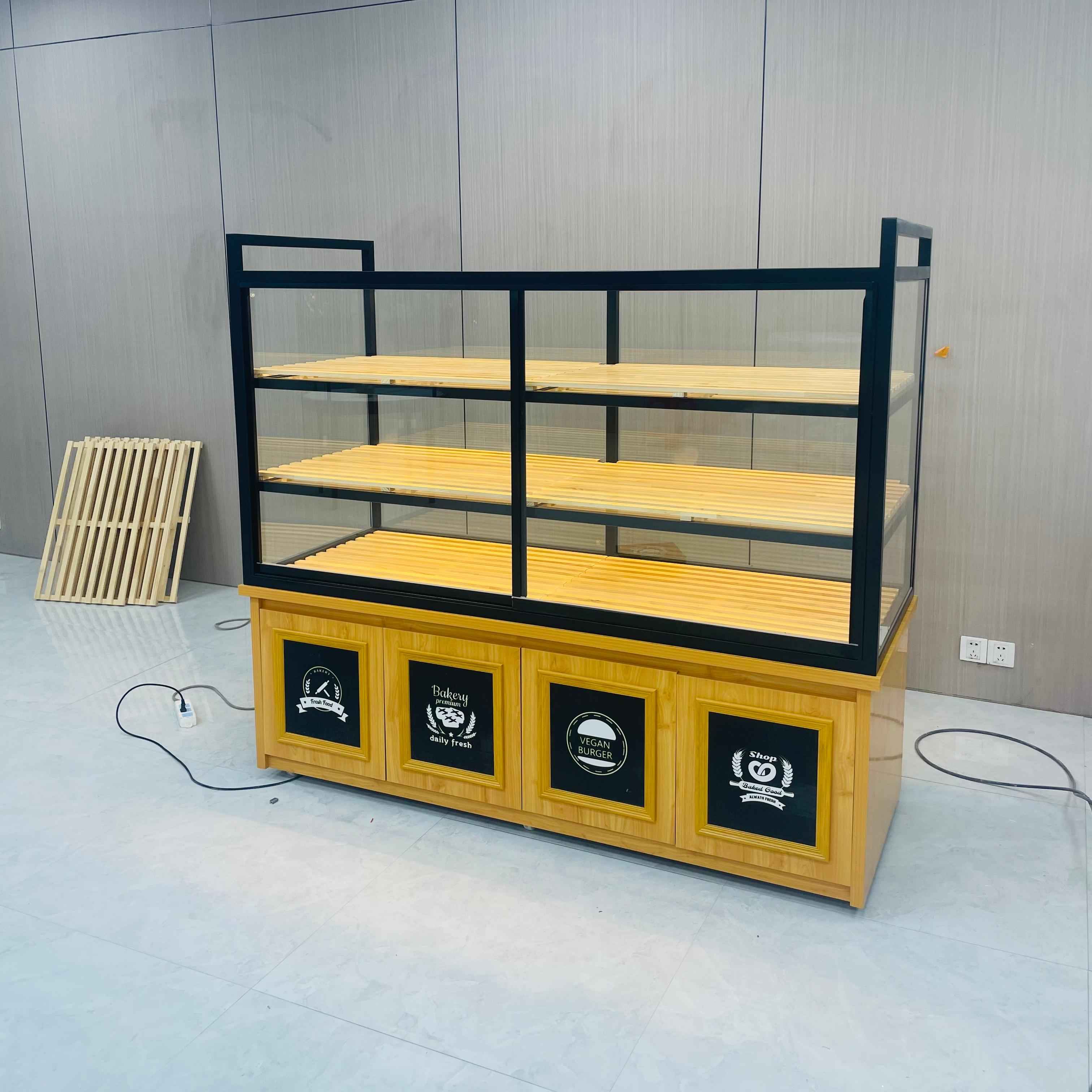
An enclosed bakery display cabinet utilizes glass fronts and rear sliding doors to create a controlled internal environment. These mechanics seal the product away from the retail floor. They require staff intervention for every purchase. The design prioritizes preservation and presentation over immediate accessibility.
The primary advantage is the physical barrier it creates. This ensures superior food safety and hygiene by maintaining a safe distance between customers and food. Airborne contaminants, sneezes, and accidental touches are completely eliminated. This barrier creates a premium presentation aesthetic. Items placed behind pristine glass are perceived as higher quality. This allows for higher price-point positioning. A high-end artisanal cupcake looks justified when presented like jewelry in a well-lit glass case. The enclosed environment protects delicate crumb structures and glazes from the drying effects of ambient air conditioning or heating. It traps the natural moisture of the baked goods, extending their shelf life by several hours compared to open-air displays.
The style of glass directly impacts visual merchandising. Curved glass profiles offer a classic European bakery aesthetic and reduce overhead glare. They can distort the product slightly at certain angles. Straight glass profiles provide a modern geometric look with zero distortion. They are popular in contemporary cafes. Anti-reflective coatings maintain a see-through premium aesthetic. They prevent store lighting from turning the glass into a mirror. For refrigerated units, dual-pane glass is mandatory to prevent condensation and maintain thermal efficiency.
Delicate, high-moisture, or sticky items require enclosed environments. Soft pretzels, scones, unwrapped cookies, frosted cakes, and high-moisture pastries belong behind glass. The enclosed space stabilizes the humidity around these items. A glazed donut left in the open air becomes sticky and weeps. Behind glass, the glaze remains stable and visually appealing.
The physical barrier inherently slows transaction times. Every purchase requires a dedicated staff member to slide the rear door, retrieve the item, and package it. During peak hours, this creates a bottleneck. These units necessitate rigorous daily cleaning. Fingerprints, smudges, and internal crumbs are highly visible. Staff meticulously sanitize glass surfaces multiple times a day to maintain the premium visibility that justifies the fixture's footprint.
Store layout dictates fixture selection just as much as the menu does. You evaluate spatial constraints, aisle widths, and total SKU counts before finalizing a floor plan. A beautiful cabinet placed in the wrong traffic flow creates congestion and frustrates customers.
Floor-standing models offer high-volume capacity and serve as primary focal points in the store. They work best for large assortments and high-traffic bakeries that display dozens of SKUs simultaneously. Countertop units optimize point-of-sale impulse purchases. Placing a small enclosed countertop case next to the register allows you to highlight premium, high-margin items like macarons or specialty truffles right where the customer opens their wallet.
Center-store layouts often suffer from dead floor space. A bakery island display cabinet solves this by creating a 360-degree shoppable fixture. These units optimize multi-directional foot traffic. They allow several customers to browse simultaneously without forming a linear queue. Islands effectively merchandise ambient, packaged goods, seasonal promotions, or high-volume items that do not require staff fulfillment. They break up the visual monotony of straight aisles and encourage exploration.
For long retail spaces, integrating multiple cases into a continuous linear run creates a seamless customer journey. This modular approach guides the shopper logically. A common layout starts with ambient breads, transitions to dry pastries, and ends with refrigerated premium desserts nearest the register. This progression builds anticipation. It allows you to mix open and enclosed formats while maintaining a unified architectural look along the service counter.
Selecting between temperature zones requires differentiating based on product chemistry rather than traditional category names. A cake does not automatically require refrigeration just because it is a cake. The specific frosting and filling dictate the environment.
Ambient storage requires specific airflow management. A dry bakery display cabinet protects items from dust and customers while maintaining room temperature. This is the precise environment needed for a glass bread display cabinet. Refrigerating bread accelerates starch retrogradation, causing it to stale rapidly. A dry glass enclosure preserves the crust's integrity while keeping the interior crumb soft, without the detrimental effects of cold air circulation.
Regulatory shifts emphasize that product formula dictates refrigeration needs. Health inspectors evaluate pH levels and water activity. Items with high dairy content, custards, meat fillings, or low-acid fruit preserves legally require refrigeration to prevent bacterial growth. You audit your recipes. If a product falls into the potentially hazardous food category, a refrigerated enclosed case is non-negotiable, regardless of your visual merchandising preferences.
Illuminating baked goods requires specialized LED lighting. Selecting the right color temperature is critical. Warm lighting enhances the golden-brown hues of breads, croissants, and crusts. Cool lighting makes white frostings, fresh fruits, and refrigerated cakes look crisp and vibrant. LEDs prevent adding internal heat. Traditional bulbs emit heat that disrupts the ambient temperature of a dry cabinet or overworks the compressor in a refrigerated unit. This leads to mechanical failure and spoiled food.
Refrigerated enclosed cases face the technical challenge of condensation. When cold air inside meets warm, humid store air on the outside glass, fogging occurs. This ruins visual merchandising. High-quality units utilize anti-fog technologies. They use heated front glass or specialized airflow baffles that direct a curtain of dry air across the interior pane. Evaluating a unit's condensation management system is critical for stores located in humid climates or spaces with poor HVAC control.
As operations scale, buyers decide when to transition from standard catalog options to bespoke builds. This decision balances upfront capital expenditure against long-term brand equity and spatial optimization.
Standard, off-the-shelf units offer lower upfront capital expenditure and highly predictable lead times. Manufacturers produce these units in high volumes, meaning you can often have one delivered and installed within a matter of weeks. If a compressor fails or a glass pane breaks, standard replacement parts are readily available from local service technicians, minimizing equipment downtime. These units fit new concepts, single-location cafes, or operators who need to launch quickly without the delays associated with custom manufacturing. They come in standard widths, allowing you to plan your cabinetry around known dimensions.
Investing in a custom bakery display cabinet provides a measurable return for multi-unit franchises or high-end artisanal shops. Custom millwork allows you to seamlessly integrate the fixture into your specific brand aesthetics. You match wood grains, metal finishes, and countertop materials exactly to your interior design package. Custom dimensional scaling ensures the unit fits perfectly into irregular floor plans. It eliminates awkward gaps or wasted space common in older buildings. You specify exact shelving depths to accommodate your specific baking sheet sizes, maximizing every inch of internal volume. While the initial cost and lead time are higher, a bespoke unit elevates the entire perceived value of the retail environment.
Purchasing the equipment is only the first step. Operators address the hidden operational costs and workflow disruptions associated with new display installations to ensure a smooth rollout.
Analyze how the case will be loaded during operating hours. Open cases typically require front-loading. Staff step out onto the retail floor to restock. This disrupts customer traffic and looks unprofessional during peak rushes. You schedule restocking during lulls in traffic to minimize interference. Enclosed cases utilize rear-loading via sliding doors. Staff restock continuously from behind the counter without ever crossing paths with the customer. This maintains a smooth operational flow. Rear-loading also allows for better inventory rotation. Staff naturally push older items to the front of the shelf while loading fresh items from the back, ensuring proper inventory management.
Factor in the daily labor hours required for maintenance. Enclosed units require staff to clean crumb trays, sanitize glass, and wipe down shelving tracks. Refrigerated units demand monthly maintenance of compressor coils. Clogged coils lead to immediate temperature failures. Create strict standard operating procedures for cleaning. A dirty display case instantly signals poor hygiene to customers and destroys the premium presentation you invested in.
Never finalize a purchase order without consulting local municipal health codes. Ensure sneeze guard heights, angles, and material specifications meet exact local requirements. Some jurisdictions require specific NSF certifications for food zone materials. Failing to verify these details before installation results in a failed health inspection. You then have to modify or completely replace the fixture before opening your doors.
The choice between open and enclosed formats depends entirely on the specific intersection of your product type, labor model, assortment size, and store volume. Maximizing profitability requires matching the physical fixture to the operational reality of your bakery. You deploy open cases for high-volume, packaged, or hard-crust items in self-service environments where speed is the priority. You reserve enclosed cases for premium, delicate, or unwrapped items that require staff fulfillment, extended freshness, and a high-end presentation.
To move forward effectively, take the following actions:
Audit your current product formulas and categorize every SKU by its legal refrigeration requirements and moisture sensitivity.
Measure your available floor space, ensuring you account for ADA-compliant aisle widths and staff working clearances behind the counter.
Map out your peak-hour customer journey to identify where bottlenecks currently occur.
Consult with your local health department to verify sneeze guard and sanitation regulations before finalizing any equipment purchase.
A: A dry case maintains ambient room temperature and controls airflow to protect items like breads and dry pastries from staling. A refrigerated case utilizes a compressor to maintain temperatures below 41°F (5°C). Product formulas with high water activity, dairy, meat, or low-acid ingredients legally require refrigerated cases to prevent bacterial growth and ensure food safety.
A: Yes, but strictly under specific health code conditions. You must install compliant sneeze guards at the correct height and angle to block airborne contaminants. You must provide dedicated tongs, tissue paper, and clear signage instructing customers on proper self-service hygiene to prevent direct hand contact with the food.
A: Keep the cabinet dry and at ambient room temperature. Avoid refrigeration entirely, as cold temperatures accelerate starch retrogradation, causing bread to stale rapidly. The glass enclosure protects the bread from aggressive HVAC air currents, preserving the crust's texture while trapping just enough natural moisture to keep the interior crumb soft.
A: Yes. Enclosed cases provide a physical barrier that completely separates the food from the retail environment. They act as a full sneeze guard, prevent airborne contaminants from settling on the product, and eliminate the risk of direct customer handling or cross-contamination associated with self-service tongs.
A: It is a freestanding fixture designed to maximize dead space in the center of a retail floor. It allows for 360-degree merchandising, enabling multiple customers to browse ambient, packaged, or dry goods simultaneously from all sides without forming a linear queue, thereby increasing overall store throughput.
A: You generally need a minimum of 36 to 42 inches of clearance behind the counter. This provides enough space for staff to comfortably slide open the rear doors, bend down to retrieve items from lower shelves, and safely pivot to the packaging station or point-of-sale system without colliding with other workers.
A: Specialized LED lighting is required because it does not emit heat that could melt frostings or disrupt internal temperatures. Use warm LEDs (2700K-3000K) to enhance the golden colors of breads and pastries, and cool LEDs (4000K+) to highlight the bright whites and vivid colors of frosted cakes and fruit tarts.


